


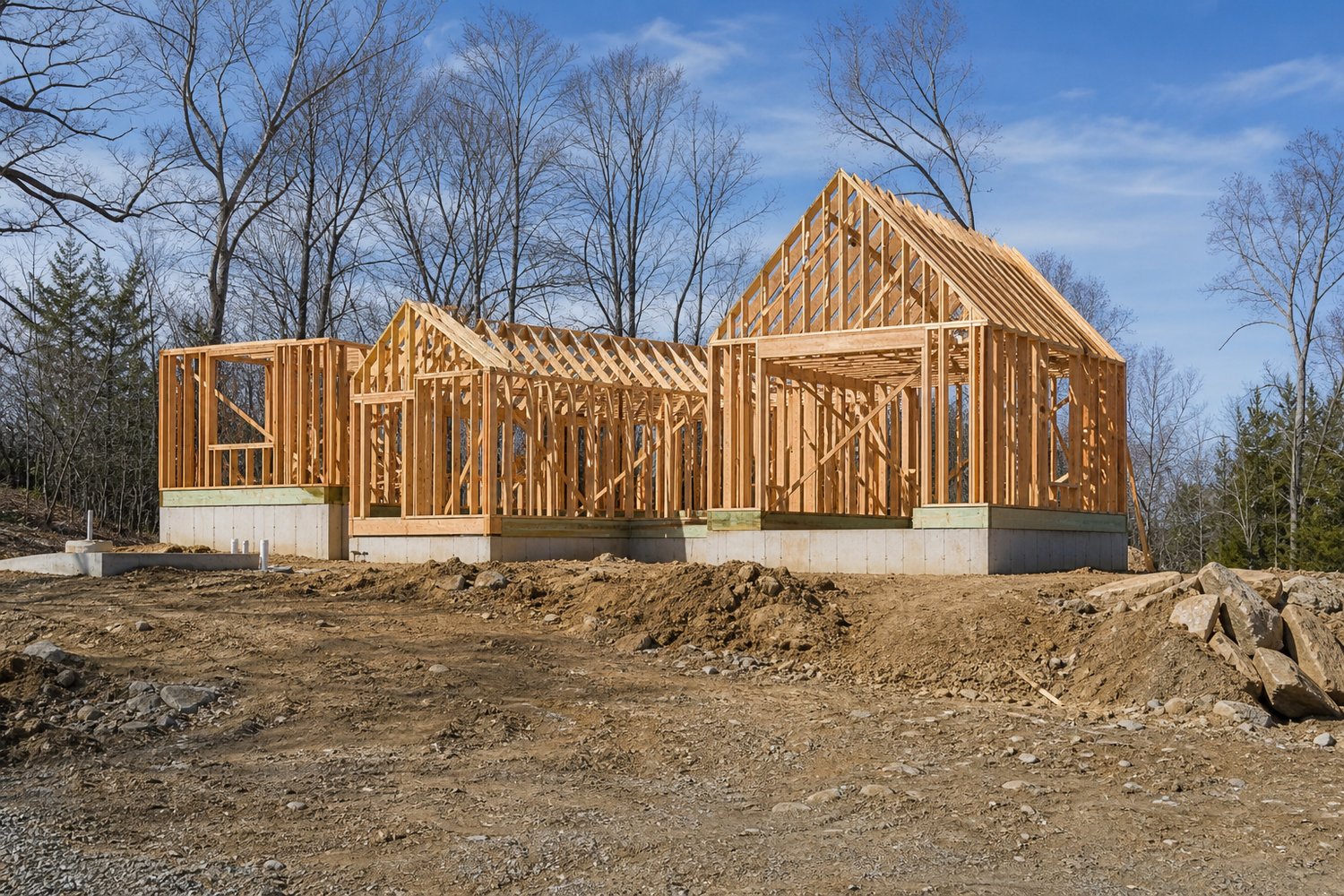
Before you tour a model home, find out whether you're buying a finished spec home, one under construction, or one not yet built. That single fact controls your price certainty, your closing date, and how much you can change. Then lock the base price, upgrade schedule, and delay terms into the contract.
What should you know before buying new construction in the Worcester / Providence Corridor?
Know the build stage first. Across the Worcester / Providence Corridor, a finished spec home, a home under construction, and a to-be-built home differ in price certainty, closing timing, and how much you can change. Get the base price, the options schedule, and the completion terms in writing, and arrange your own inspections along the way.
Key Takeaways
- Worcester County's median listing price was $550,000 with a median of 46 days on market in September 2026, according to Realtor.com.
- Providence County's median days on market was 32 in August 2026 per FRED, so the two sides of the corridor are moving at different speeds.
- Rhode Island's statewide median listing price was $590,000 in October 2026, per Realtor.com, but that is a resale-inclusive statewide number, not a new-construction price.
- The base price is rarely the final price, because options, site work, and lot-specific items can change what you owe.
- Your financing approval has to stay valid through construction and closing, so confirm that with your lender before you sign.
What does the Worcester / Providence Corridor market look like for new-home buyers?
It's two markets, not one. The Worcester / Providence Corridor is not an official housing market, and the Massachusetts and Rhode Island sides move at different paces.
Here are the most recent public indicators I'd use as a starting point.
| Area | Measure | Figure | Period |
|---|---|---|---|
| Worcester County, MA | Median listing price; median days on market | $550,000; 46 days | September 2026 |
| Worcester (city) | Median days on market; active listings | 46 days, up 24.3% year over year; listings up 27.8% | August 2026 |
| Providence County, RI | Median days on market | 32 days | August 2026 |
| Providence (city) | Median days on market | 33 days | October 2026 |
| Rhode Island (statewide) | Median listing price; median days on market; active listings | $590,000; 37 days; about 4,300 | October 2026 |
Sources: Realtor.com, Worcester County; Realtor.com, Worcester; FRED; Realtor.com, Providence; and Realtor.com, Rhode Island.
These are portal-based figures covering all homes, so read them as a direction, not a new-construction price. Worcester shows more inventory and slower marketing times. Providence-area homes are moving faster. Treat them as separate snapshots.
Where does new construction actually get built?
Where land, approvals, and utilities line up. Parcel size, sewer or septic capacity, wetlands, zoning, and subdivision approvals shape new-home availability more than countywide demand does.
On the Massachusetts side, I watch towns like Grafton, Uxbridge, Sutton, and Millbury. In Rhode Island, I follow Cumberland, Lincoln, North Smithfield, and Smithfield. I break down one of those in the advantages of buying new construction in Cumberland, RI . If you're leaning toward a condo instead, read what buyers should know about new construction condos in Worcester County .
How does buying new construction work, step by step?
You identify the build stage, vet the builder's paperwork, line up financing that outlasts construction, and inspect at set points before closing. The stage you're buying at decides how much of that applies.
Which build stage are you buying?
- Completed spec home: You can walk it, inspect it, and close on a familiar timeline. You have little say over finishes.
- Under construction: You may still choose some finishes, but the completion date is an estimate, and your financing has to line up with it.
- To-be-built: You have the most design input and the least certainty on final price and delivery date.
What are the steps?
- Get your financing in order. Ask your lender whether your approval stays valid through the expected construction and closing period, and what happens if the schedule slips.
- Confirm exactly what the quoted price includes. Ask whether it covers selected options, site work, appliances, landscaping, and the driveway.
- Review the standard specifications and the upgrade schedule. Know what is standard before you fall for a model home that is loaded with extras.
- Pin down the completion window. Get it in writing, along with what happens if delivery is delayed.
- Schedule independent inspections. Ask for an inspection before drywall where access is permitted, a pre-closing inspection, and any applicable warranty inspection.
- Compare against nearby resale homes. Look at taxes, utility arrangements, road status, HOA obligations, and future development plans.
- Close with your closing agent. Your closing agent handles the settlement and the funds, so loop them in early.
Timeline is the question I hear most. A finished home can close on a normal schedule. A home not yet built depends on the builder's estimated completion window, which is why delay terms matter. I'll walk you through the contract language before you commit.
What costs and problems should you plan for with a new build?
Plan for the difference between the advertised base price and your final price. Builder pricing is specific to the project, so the real number lives on the builder's current price sheet, not in a market average.
What can push the final price up?
- Upgrades and options selected beyond the standard specifications.
- Lot premiums and site work, which vary by parcel.
- Items outside the base price, such as appliances, landscaping, and driveway work.
- HOA obligations and property tax on the newly assessed home. Ask the town assessor how new homes are handled.
I'm not going to guess at dollar amounts here, because they change by builder, lot, and town. Once we've picked a project, I'll help you compare the builder's price sheet against nearby resale homes so you can see whether the premium makes sense. For a fuller picture of the cash side, see how much cash you need to buy in Worcester or Providence .
What challenges show up outside established neighborhoods?
Utilities and infrastructure. Newer subdivisions in the corridor may involve private wells, septic systems, shared private roads, and propane or oil heat. Each affects monthly operating costs and, later, resale appeal.
Ask who maintains the road, whether municipal services are planned, and what any future infrastructure obligations would be. Confirm your lot's details with the town building department.
What about delays and changes?
Delays happen, so protect yourself on paper. A completion date is an estimate until the home is done. If your lease ends or your rate lock expires first, you need a plan. If you're a first-time buyer, my first-time home buyer checklist for Worcester County covers the groundwork. Buying a detached home? Start with buying single-family homes in the Worcester / Providence Corridor.
FAQ
What is the price premium for new construction in Worcester compared with an existing home?
There's no single honest premium to quote, because it varies by builder, lot, and finish level. The way to find yours is to compare the builder's current price sheet against recent sales of similar resale homes nearby. I'll run that comparison with you for the specific project you're considering.
Is new construction more affordable in the Rhode Island portion of the corridor?
Not necessarily, and the public numbers can't answer it. Rhode Island's statewide median listing price was $590,000 in October 2026, while Worcester County's was $550,000 in September 2026, but those cover all homes in different geographies. Compare specific projects, not statewide medians.
Which towns along the corridor have the most new-home development?
It depends on where land, sewer or septic capacity, wetlands rules, and subdivision approvals allow building. I follow active projects in places like Grafton, Uxbridge, Cumberland, and Lincoln. Ask me which are active now.
Can I use my own buyer's agent when purchasing from a builder?
Yes, that's your decision, and the sales representative at the model home works for the builder. Ask the builder how they handle buyers who bring an agent, and bring yours in before your first visit so you aren't negotiating alone.
What inspections should I order for a newly built home?
Order an independent inspection before drywall where the builder allows access, a pre-closing inspection, and any warranty inspection that applies. A new home isn't automatically defect-free, and an independent inspector works for you.
Ready to compare a builder's price against the resale market?
New construction rewards buyers who nail down the stage, the inclusions, and the delay terms before signing. Whether you're looking in Grafton, Uxbridge, Cumberland, or Lincoln, I'll help you read the contract and compare the project against nearby resale homes.
Let's discuss your options: call or text (774) 225-8916. If you're selling a current home to buy new, you can also request a home valuation .
About Fawaad I. Qamar
Fawaad I. Qamar is a REALTOR® with Whitestone Realty Group serving buyers and sellers across the Worcester/Providence corridor. He specializes in new construction and first-time home buyers in communities like Grafton, Uxbridge, Cumberland, and Lincoln, with a data-driven, trusted-advisor approach.
Whitestone Realty Group | (774) 225-8916
Equal Housing Opportunity. Fawaad I. Qamar, REALTOR®, Whitestone Realty Group. License: MA and/or RI license number(s) pending. Regulated by the Massachusetts Association of Realtors (MAR), the Rhode Island Association of Realtors, and the National Association of Realtors (NAR). This article is general information, not legal, tax, or financial advice. Confirm your own numbers with your closing agent, tax advisor, or lender.