


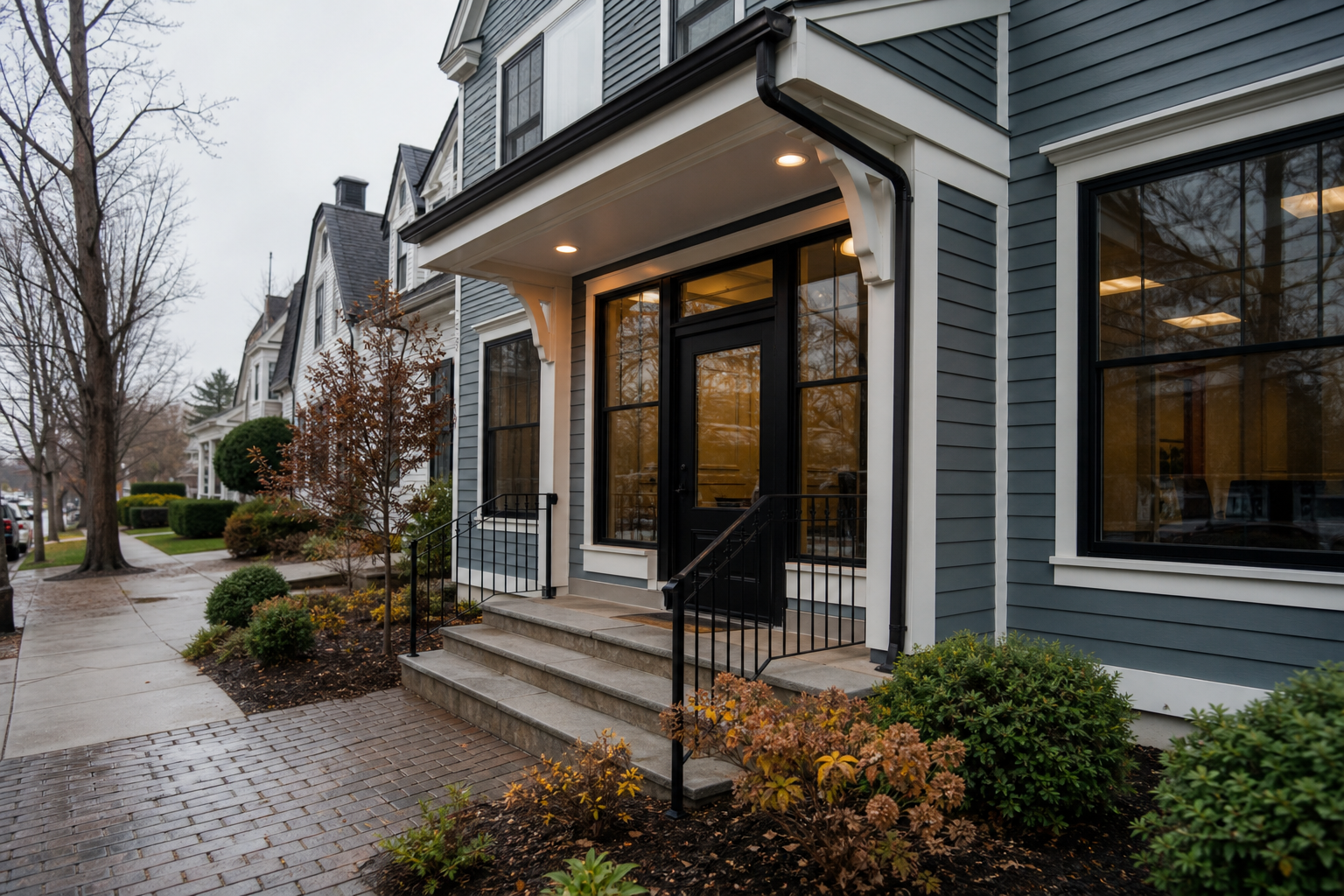
Buying a condo in the Worcester / Providence Corridor means reviewing association documents, understanding Massachusetts General Laws Chapter 183A, analyzing reserve funds, and confirming fee and assessment status before closing. The process has more moving parts than a single-family purchase, and the association's financial health matters as much as the unit itself.
Buying a condo in the Worcester / Providence Corridor is a different process than buying a single-family home. You're not just purchasing a unit, you're buying into an association, a shared budget, and a legal structure governed by Massachusetts General Laws Chapter 183A . The association's financial health, reserve position, and pending assessments can affect your mortgage approval, your monthly costs, and your ability to resell or rent the unit later.
Key Takeaways
- Massachusetts condominiums are created under General Laws Chapter 183A, which governs how ownership, common areas, and percentage interests are structured.
- The Massachusetts 6(d) certificate verifies that a seller has paid all required condo fees and assessments; unpaid balances can cloud the title and affect your closing.
- A condo association's reserve fund health matters as much as the monthly fee; thin reserves signal a higher risk of special assessments after you close.
- Lenders apply stricter guidelines to condos in buildings with low reserves, high investor ownership, or pending litigation; these factors can limit your financing options.
- Older mill-conversion and urban condos in Worcester and Providence carry unique diligence risks around shared mechanical systems, parking, and deferred maintenance.
How does the Massachusetts condo legal structure affect your purchase in the Worcester / Providence Corridor?
Every Massachusetts condominium is created by a master deed recorded at the county registry. That document defines the land and buildings, the portions owned individually versus commonly, any limited common elements such as a deeded parking spot or private deck, and each unit's percentage interest.
Your percentage interest determines your share of common expenses. It's built into the legal structure, not something the association sets arbitrarily.
In the Worcester / Providence Corridor, associations are commonly organized as trusts with elected trustees rather than a traditional board-run corporation. That's a Massachusetts-specific structure, and it matters when you're reading the governing documents. The trust document, master deed, bylaws, and rules and regulations all work together, and a conflict between them can create real problems for owners.
I walk every condo buyer I work with through the full document stack before we remove contingencies. It's not glamorous reading, but it's where the real risk lives.
What documents should you request before making an offer?
Request these before you're under contract, or at minimum as a contingency condition. According to Massachusetts closing guidance from the Division of Occupational Licensure , condo buyers should review:
- The master deed and unit deed
- Declaration of trust and bylaws
- Rules and regulations
- Association budget, current year and prior year
- Reserve fund balance and any reserve study
- Master insurance policy
- Assessment history and any pending or planned special assessments
- Meeting minutes from the past 12 to 24 months
- The unit's fee and assessment payment status
Meeting minutes are often the most revealing document in the stack. They'll tell you whether the roof replacement has been deferred for three years, whether there's an ongoing dispute with a contractor, or whether the trustees are aware of a structural issue they haven't yet addressed. I've seen buyers walk away from a unit they loved because the minutes flagged a $40,000 special assessment the seller hadn't mentioned.
What is a Massachusetts 6(d) certificate and why does it matter at closing?
A Massachusetts 6(d) certificate confirms that the seller has paid all required condominium fees and assessments as of the date it's issued. It's a critical closing document because Massachusetts law gives condo associations lien rights for unpaid common-area charges, including a statutory priority lien in qualifying circumstances. If the seller is behind on fees and you close without a clean 6(d), that liability can attach to the unit, and to you. Your closing agent will require this document before the transaction settles.
Does the association have a right of first refusal?
Some Massachusetts condominium documents give the association or its members the right to purchase a unit on the same terms as a bona fide outside offer, within a specified window. This is not an automatic feature of every Massachusetts condominium, it's document-specific. If the documents include a right of first refusal, your offer timeline needs to account for it. I check for this in every set of condo documents I review with a buyer, because a surprise right of first refusal can derail a deal at the worst possible moment.
What financial red flags should Worcester / Providence Corridor condo buyers watch for?
The monthly fee is the first number most buyers focus on, but it's often the least informative one. What the fee covers varies widely by association; some include heat, water, exterior maintenance, and amenities, while others cover only basic insurance and landscaping. Two condos with the same monthly fee can have completely different risk profiles depending on the reserve fund behind them.
How do you evaluate a condo association's reserve fund?
A reserve fund is the association's savings account for major capital expenditures: roofs, elevators, parking structures, HVAC systems, and common-area windows. A well-funded reserve means the association can absorb those costs without levying a special assessment on owners. An underfunded reserve is a warning sign. It means you may face a significant one-time charge after you close, on top of your regular monthly fee.
Ask for the most recent reserve study if one exists. If the association hasn't conducted a reserve study, that's itself a flag. Compare the current reserve balance against the study's recommended funding level. If the association is below 70% funded, budget for the possibility of a special assessment in the next few years.
This is exactly the kind of analysis I run through with every buyer before we go under contract. Your specific exposure depends on the building's age, condition, and what the trustees have deferred, and that's a conversation worth having before you're emotionally committed to a unit.
How does a pending special assessment affect your purchase?
A pending special assessment is a known, upcoming charge the association has voted to levy on owners. If one is in place when you close, you'll owe your share, sometimes immediately. Whether the buyer or seller pays a pending assessment is negotiable and depends on what your purchase contract specifies. Don't assume the seller absorbs it. Confirm the status of any pending or recently completed assessments in writing before you finalize your offer terms.
How does building financial health affect your financing?
Lenders apply additional guidelines to condo purchases that don't apply to single-family homes. A building with low reserves, significant deferred maintenance, pending litigation, or a high percentage of investor-owned units may not meet conventional or FHA financing guidelines.
If a building isn't warrantable, your loan options narrow, and so does your future buyer pool when you go to sell. I always verify a building's financing eligibility early in the process, before a buyer falls in love with a unit that can't be financed the way they planned.
If you're still sorting out your financing picture, my post on how much cash you need to buy a home in Worcester or Providence covers the full upfront cost picture, including what to expect at closing.
| Document or Factor | What to Look For | Why It Matters |
|---|---|---|
| Reserve fund balance | Percentage funded vs. reserve study recommendation | Underfunded reserves increase special-assessment risk |
| Meeting minutes | Deferred maintenance, disputes, planned projects | Reveals issues not visible in the budget or fee schedule |
| Massachusetts 6(d) certificate | Confirms seller has paid all fees and assessments | Unpaid balances can create a lien on the unit at closing |
| Master insurance policy | Coverage type, bare walls vs. all-in, deductible | Determines what your personal HO-6 policy needs to cover |
| Investor ownership percentage | Percentage of units owner-occupied vs. rented | High investor concentration can affect conventional and FHA financing eligibility |
| Pending litigation | Any active or threatened legal action against the association | Litigation can block financing and signal deeper structural or governance problems |
What's different about buying a condo in Worcester versus Providence-area communities?
The Worcester / Providence Corridor spans two states and a wide range of building types, and the diligence picture shifts depending on where you're buying. Worcester and its surrounding communities, Grafton, Uxbridge, and Attleboro, sit on the Massachusetts side, governed by Massachusetts General Laws Chapter 183A . Providence, Cumberland, and Lincoln fall under Rhode Island's condominium statutes, which have their own resale-certificate requirements and disclosure framework.
Both sides of the corridor contain significant older housing stock, including mill-conversion condominiums that carry distinctive diligence considerations: shared mechanical systems, elevators, parking structures, flood exposure in lower-level units, historic-building restrictions, and sometimes commercial tenants in the same building.
For any older or converted building, the association's capital plan, reserve study, and recent assessment history tell you far more than the monthly fee does. I pay particular attention to roof, masonry, plumbing, electrical, and heating systems in any building that predates the 1980s. Deferred maintenance in those systems tends to show up as expensive surprises for owners.
If you're considering a first purchase in this corridor and want a broader framework for the process, the first-time home buyer checklist for Worcester County covers the full sequence from pre-approval through closing.
The right condo for your situation depends on your financing, your timeline, and your tolerance for association governance, and the only way to know where a specific building lands on all of those dimensions is to run through the documents with someone who knows this market.
FAQ
What should I review in a Massachusetts condo association's financial documents before making an offer?
Focus on the reserve fund balance relative to any reserve study, the current and prior-year budgets, the assessment history, and the meeting minutes from the past one to two years. The budget tells you what the association spends; the reserve study tells you whether they're saving enough for major repairs; and the minutes tell you what the trustees know but haven't yet budgeted for. Thin reserves and deferred capital projects are the two most common sources of post-closing surprises for condo buyers in Massachusetts.
What does a Massachusetts 6(d) certificate tell a condo buyer?
A Massachusetts 6(d) certificate confirms that the seller has paid all required condominium fees and assessments as of the date it's issued. It's a required closing document because Massachusetts law gives associations lien rights for unpaid common charges, including a statutory priority lien in qualifying circumstances, meaning unpaid balances can attach to the unit and affect your title. Your closing agent will not settle the transaction without a clean 6(d).
What happens if a condo association has a pending special assessment?
A pending special assessment is a known charge the association has voted to levy on owners, typically for a major repair or capital project. Whether the buyer or seller is responsible for that charge depends on what your purchase contract specifies, it's negotiable, and you should not assume the seller automatically absorbs it. Confirm the full amount, payment schedule, and allocation in writing before finalizing your offer, and factor it into your total cost of acquisition.
Can I finance a condo if the building has low reserves or significant investor ownership?
Possibly, but your options narrow. Conventional lenders following Fannie Mae guidelines and FHA both apply project-level eligibility requirements that go beyond the individual unit's value. A building with underfunded reserves, pending litigation, or a high concentration of investor-owned units may not qualify for standard financing, which limits your buyer pool when you eventually sell. I verify a building's financing eligibility early in every condo transaction, before a buyer is emotionally invested in a unit that can't be financed as planned.
Which condo expenses are negotiable between the buyer and seller?
The allocation of closing costs, prepaid condominium fees, reserve-fund transfer amounts, and any pending special assessments are all subject to negotiation and depend on what your purchase contract specifies. According to Massachusetts closing guidance , items such as advance condominium fees and reserve-fund transfers may arise at settlement, and who pays what is a contract matter, not a fixed rule. What's not negotiable is the 6(d) certificate requirement: the seller must provide one, and it must show a clean payment status for the transaction to close.
Does Rhode Island require a condo resale certificate?
Rhode Island has its own condominium statutes governing resale disclosures for the Providence-area communities in the corridor, including Cumberland and Lincoln. The resale certificate process and required contents differ from Massachusetts' 6(d) framework. If you're buying on the Rhode Island side of the corridor, I'll walk you through what the seller is required to provide and what to watch for in those documents; the specifics depend on the association and the purchase agreement.
Ready to work through the details on a specific building?
Call or text me at (774) 225-8916 or request a consultation at fawaadqamar.com. I'll pull the association documents, run through the financials with you, and tell you what I see before you're committed to anything.
About Fawaad I. Qamar
Fawaad I. Qamar is a REALTOR® with Whitestone Realty Group serving buyers and sellers across the Worcester/Providence corridor, specializing in new construction and first-time home buyers in communities like Grafton, Uxbridge, Cumberland, and Lincoln. He brings a data-driven, trusted-advisor approach to every transaction, local knowledge, strategic results.
Whitestone Realty Group | (774) 225-8916
Equal Housing Opportunity. Fawaad I. Qamar, REALTOR®, MA & RI License Pending (please provide license numbers). Affiliated with Whitestone Realty Group, a member of the Massachusetts Association of Realtors, Rhode Island Association of Realtors, and the National Association of REALTORS®. This article is general information only and does not constitute legal, tax, or financial advice; confirm your specific numbers and transaction details with your closing agent, tax advisor, or lender.